
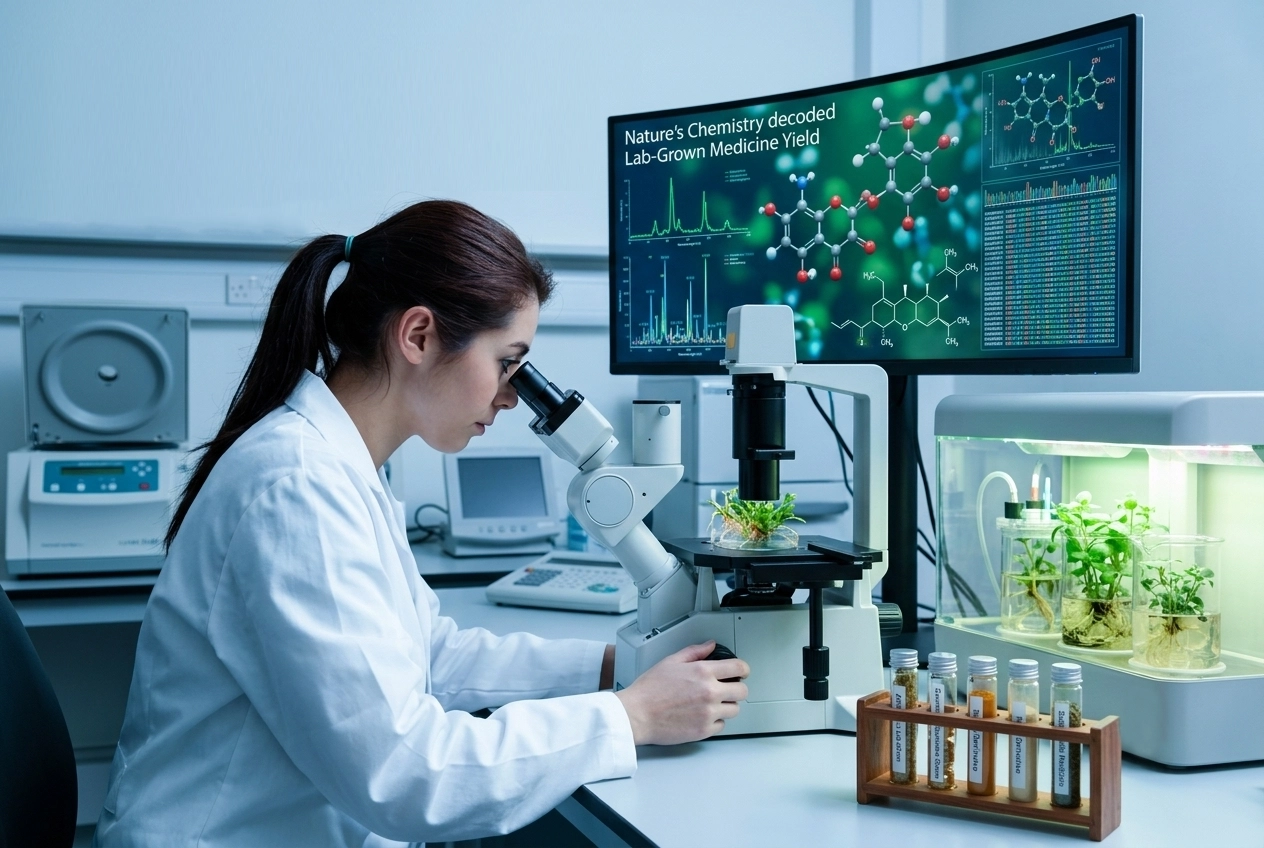
New Scientific Breakthrough Advances Sustainable Production of Plant-Derived Medicines
Two plants notorious for causing nerve toxicity and paralysis in minuscule doses are also widely recognized for their ability to combat pain, malaria, cancer, and agricultural pests. For the first time, researchers have unlocked a method to replicate these potent natural compounds within a laboratory setting, paving the way for improved, sustainably sourced therapeutics.
Focusing on the complex biochemistry of wolfsbane (monkshood) and larkspur (delphinium), the discovery is the result of a collaborative effort between scientists at Michigan State University (MSU) and the Czech Academy of Sciences. Their groundbreaking findings have been published in the peer-reviewed journal Molecular Plant.
These plants have played a significant role in traditional medicine systems across the globe for thousands of years. Understanding the precise biological mechanisms they use to build these molecules offers researchers entirely new avenues for drug screening and clinical testing.
Nature’s Ultimate Chemists
Despite the rapid progress of modern science, one fundamental truth remains: nature remains the ultimate chemical engineer. Over millions of years, plants have continuously refined their arsenal of specialized metabolites to survive and adapt.
Humans have successfully adapted many of these natural molecules for daily use. Well-known compounds like caffeine, capsaicin, menthol, and vanillin—along with a vast portion of modern pharmaceuticals—are either extracted directly from plants or modeled after plant chemistry.
At MSU, researchers focused on identifying the exact biochemical pathway that larkspur uses to generate a class of highly complex, toxic-yet-promising chemicals known as diterpenoid alkaloids. Recreating these structures in a lab, however, has historically proven to be incredibly difficult.
Diterpenoid alkaloids sit at the junction of two of the oldest and largest chemical families in the plant kingdom. Despite being isolated nearly two centuries ago, one of the most famous compounds in this group, aconitine, has never been successfully synthesized from scratch in a laboratory environment.
Mapping the Molecular Assembly Line
This scientific breakthrough was accelerated by an international partnership. Rather than working in isolation, researchers from MSU and the Czech Academy of Sciences combined their resources to study the shared biosynthetic pathways of larkspur and its poisonous relative, wolfsbane.
To map this complex process, the team conducted a molecular search across multiple plant species, tracking thousands of genes to determine which ones were activated in specific tissues at precise moments.
Biochemical pathways function much like an industrial assembly line. If a single step in a ten-step production line fails, the final product cannot be created. Because plants naturally generate these valuable compounds very slowly and in trace amounts, identifying every step of this genetic assembly line is essential for scaling up production.
Once a pathway is fully mapped, scientists can insert the genetic blueprint into an engineered host organism, such as yeast or tobacco plants. This bio-manufacturing approach allows the host to produce the target compound in much larger quantities, facilitating wider clinical testing.
By isolating a specific set of active genes from wolfsbane and larkspur and introducing them into tobacco plants, the team successfully reconstructed the biosynthetic pathway. They identified six unique enzymes that cooperate to synthesize a diterpenoid alkaloid known as atisinium. These enzymes not only fold the molecule into its final three-dimensional structure but also introduce a critical nitrogen source.
Unlocking the chemical steps needed to produce atisinium provides a vital foundation for researchers aiming to harness the medicinal properties of the broader diterpenoid alkaloid family. Ultimately, this research aims to deliver green, sustainable biotechnological tools that allow medicine to benefit from the natural defense systems of plants.